Action potential
Relate V, g, and I in the classical Hodgkin–Huxley model. Explore paired-stimulus refractoriness, strength–duration curves, and recovery from Na⁺ inactivation.
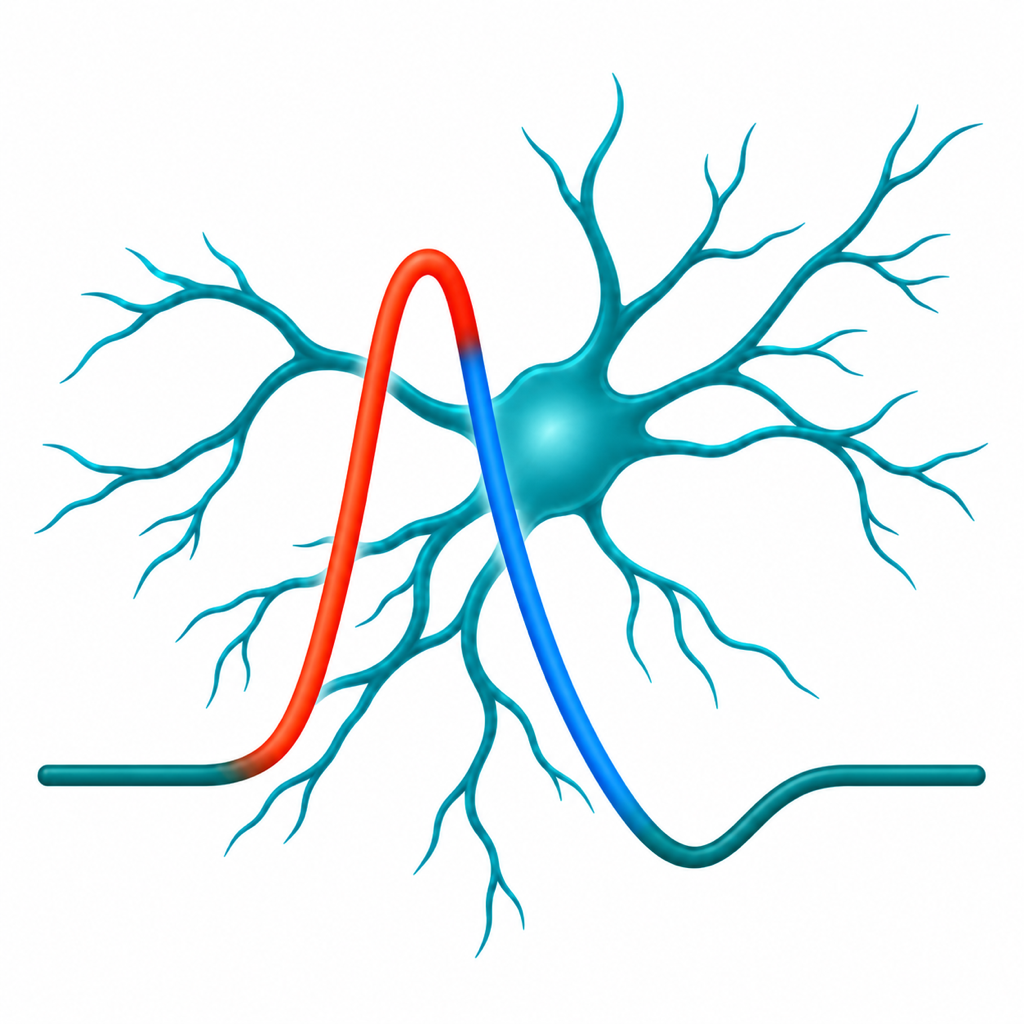
Connect neuronal physiology with waveforms and diagrams.
Change stimulus strength and duration, channel conductance, synaptic input location, and circuit connections to observe voltage and current responses. Explore six simulations spanning action potentials, dendrites, neural circuits, and axon conduction.
Action Potential Dynamics is now NeuroPhysMatrix. We have reorganized the content to focus on neuronal simulations.
Six simulations
Change parameters and connect diagrams with traces to investigate why a response changes.
Relate V, g, and I in the classical Hodgkin–Huxley model. Explore paired-stimulus refractoriness, strength–duration curves, and recovery from Na⁺ inactivation.
Compare firing rate, adaptation, delayed firing, sag, and rebound in nine representative neuron models. Four profiles are free; five additional profiles are included in Pro.
Operate 14 representative channels and background currents, including SK current. Use current and voltage clamp to change stimuli, channel availability, and maximum conductance.
Explore four presets: excitatory chains, feedforward inhibition, recurrent inhibition, and disinhibition. Change excitatory/inhibitory connection strengths and delays; compare voltage traces and spike rasters.
Combine temporal and spatial summation with dendritic integration in one workspace. Change input number, strength, timing, location, inhibition, and representative dendritic morphology.
Compare schematic myelinated and unmyelinated conduction and focal demyelination. Relate timing, voltage at nodes or recording sites, current leakage, and safety factor.
Settings & Guide
Adjust the visible range in all six workspaces to inspect fast action potentials and slower responses on suitable timescales.
Align stimulus or input graphs with voltage and conductance to identify which part of the response changes.
Read parameter meanings, graph conventions, cell-profile features, and model limitations in the in-app Guide.
Pro offers standard-trace comparison, held ion-channel and dendritic traces, and numerical comparison of recorded conditions and measurements.
In the app
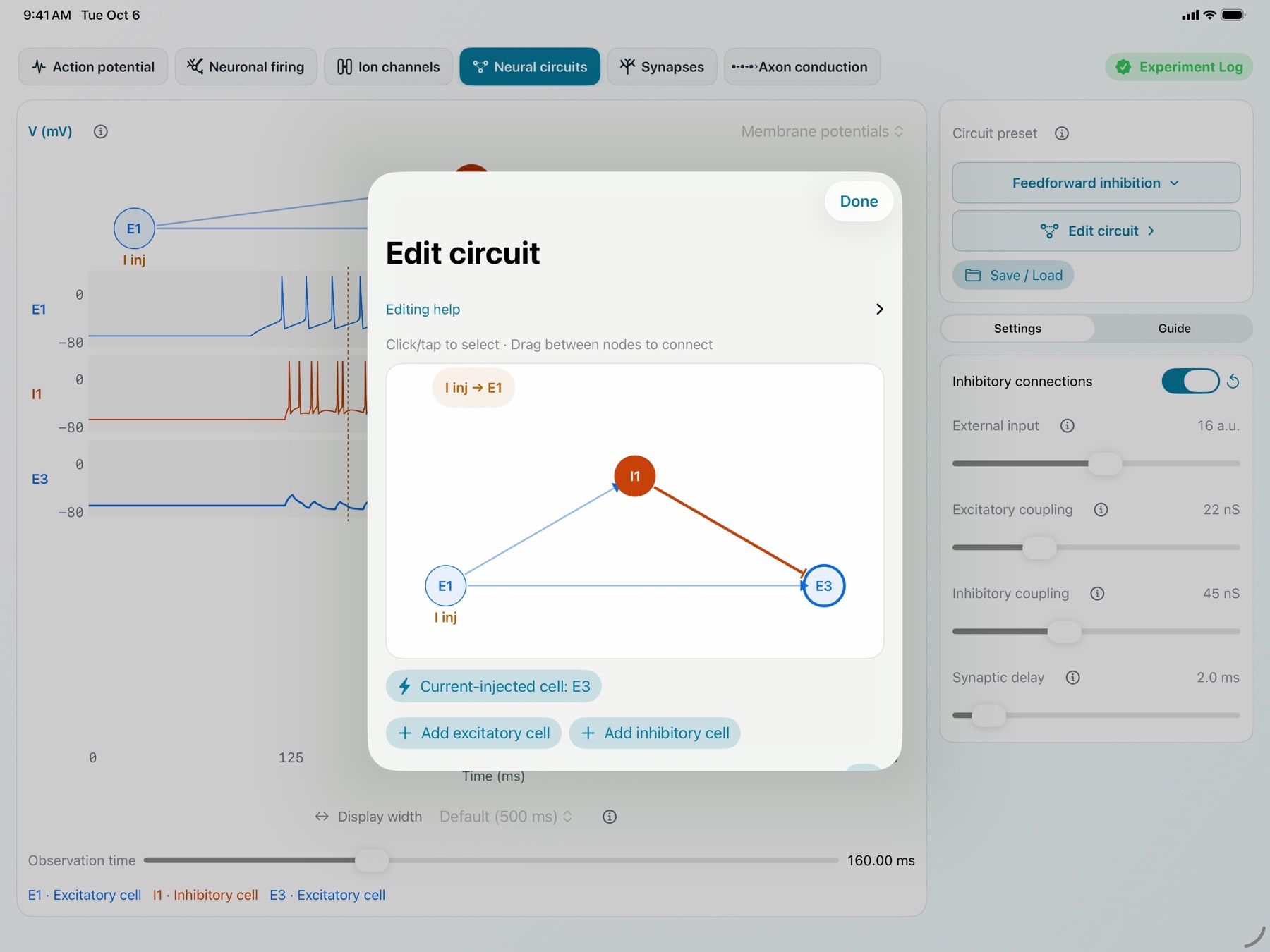
English iPad screens in landscape. Select an image to open a larger view.
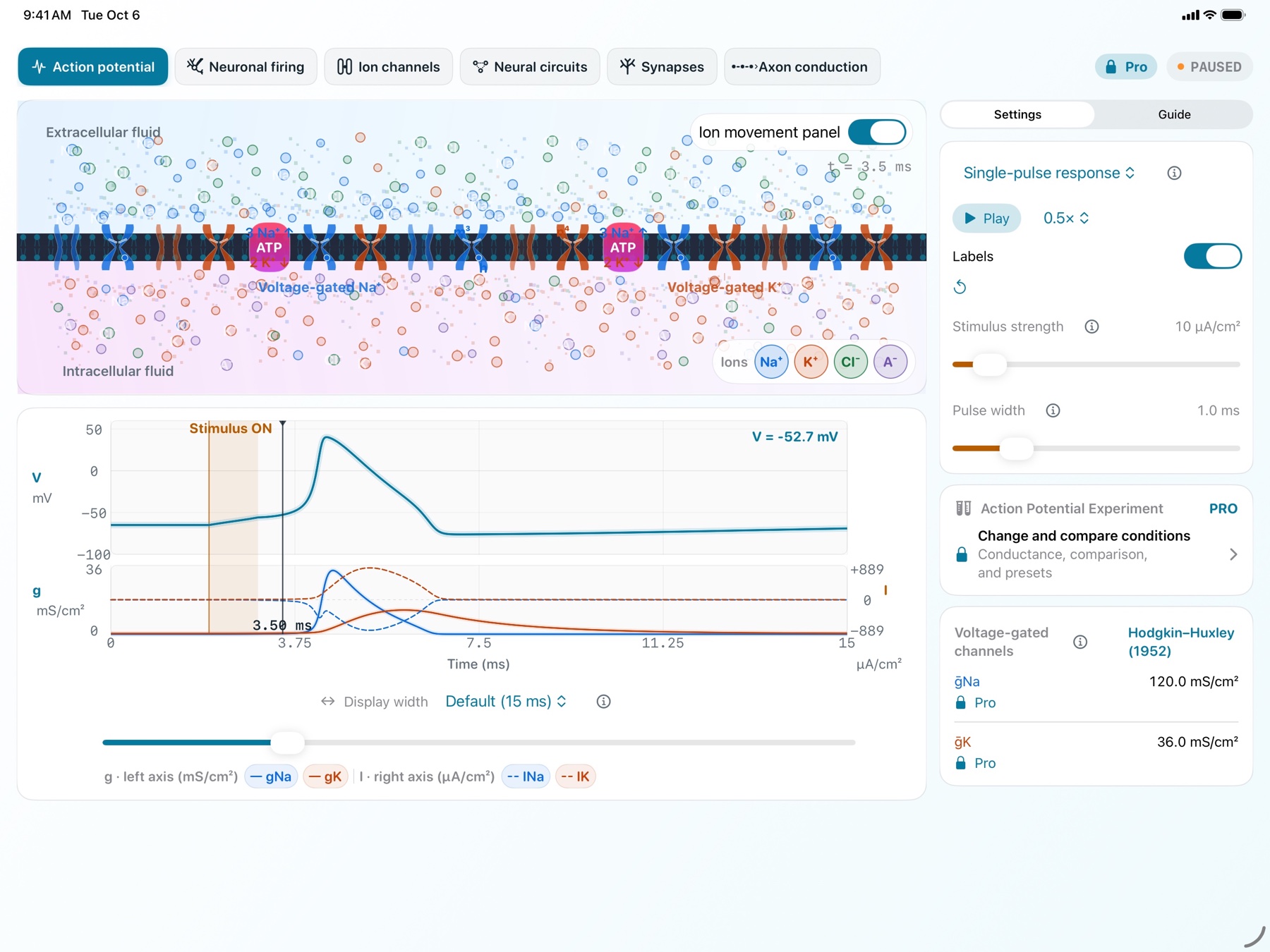
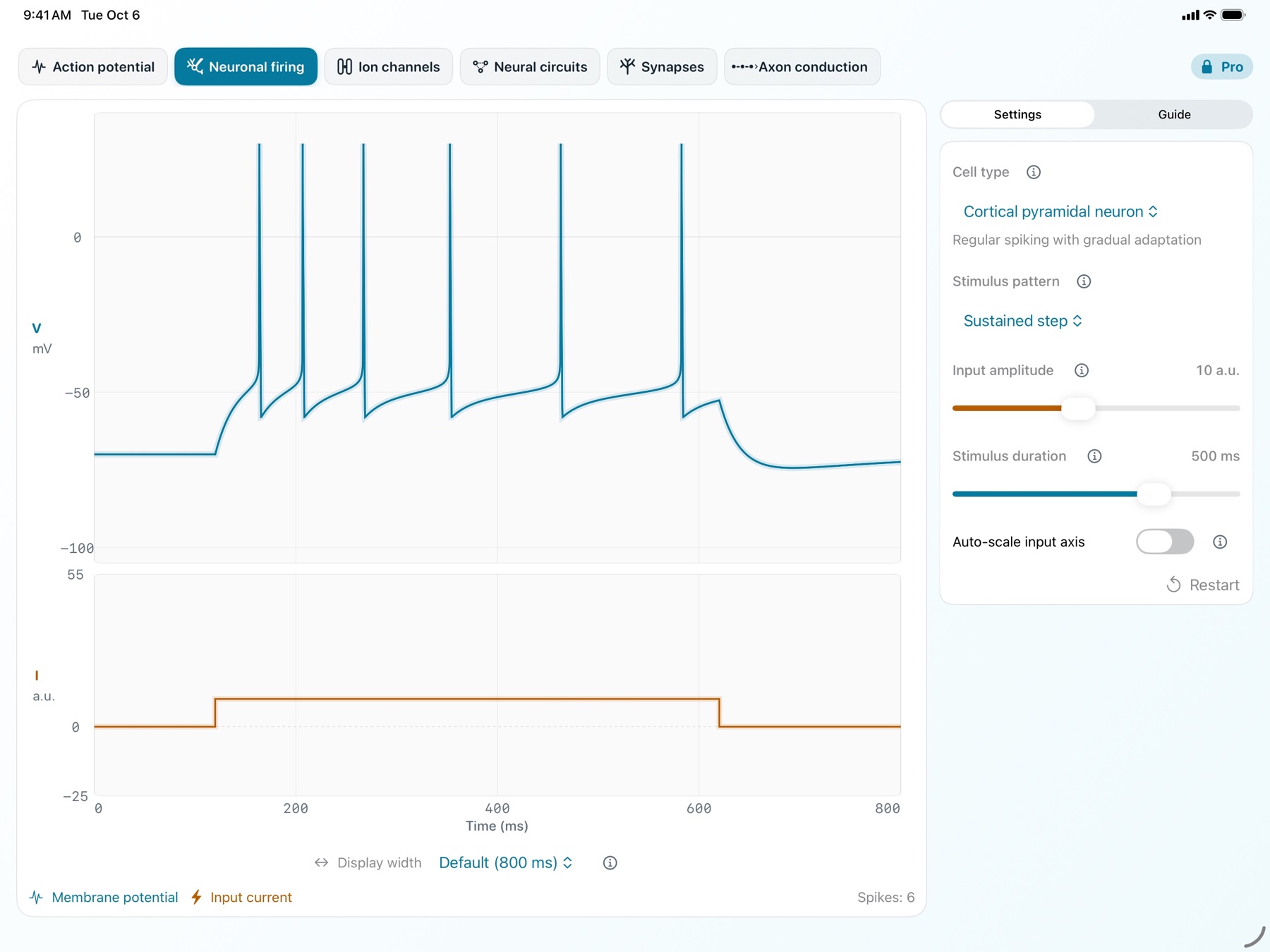
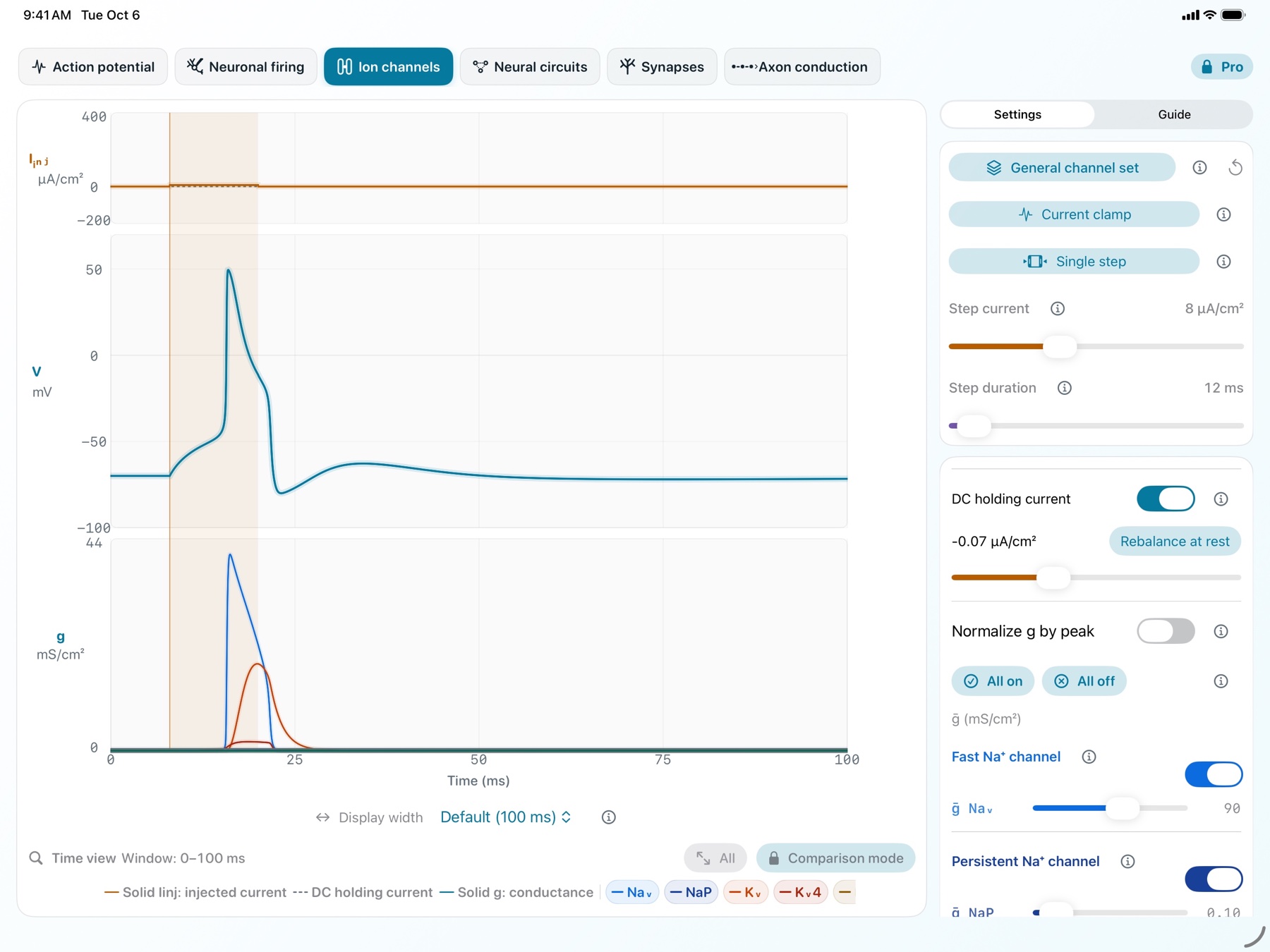
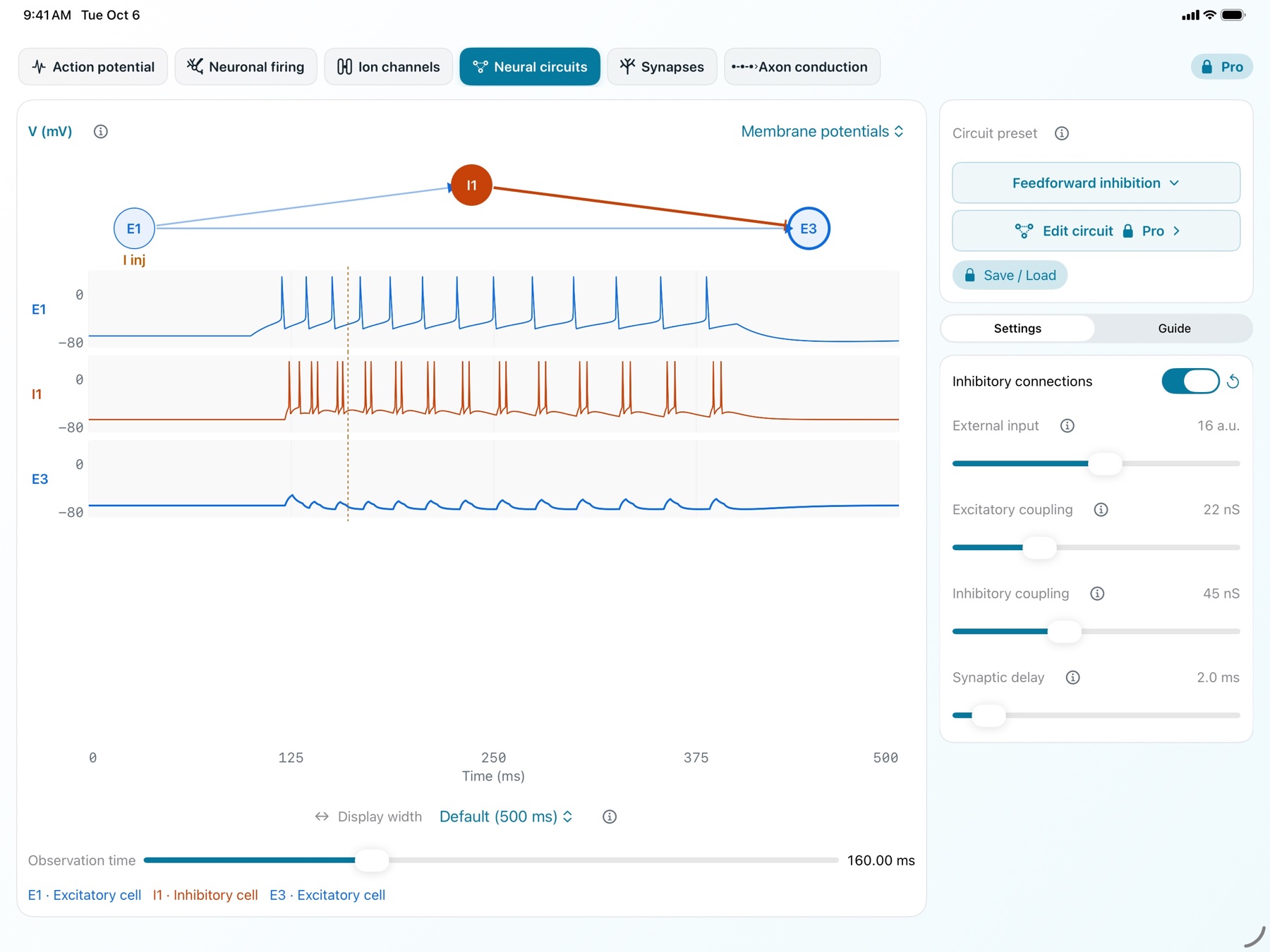
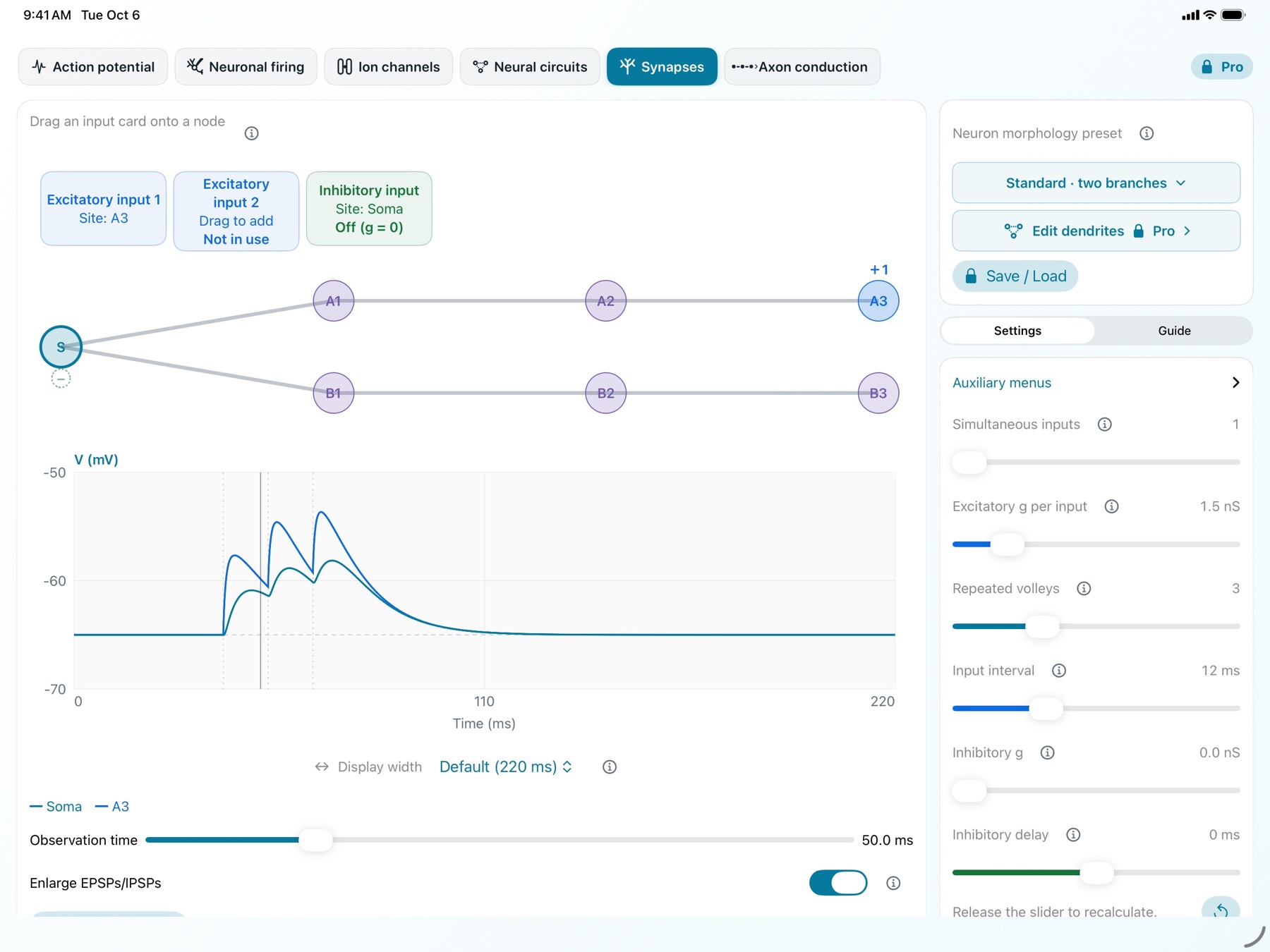
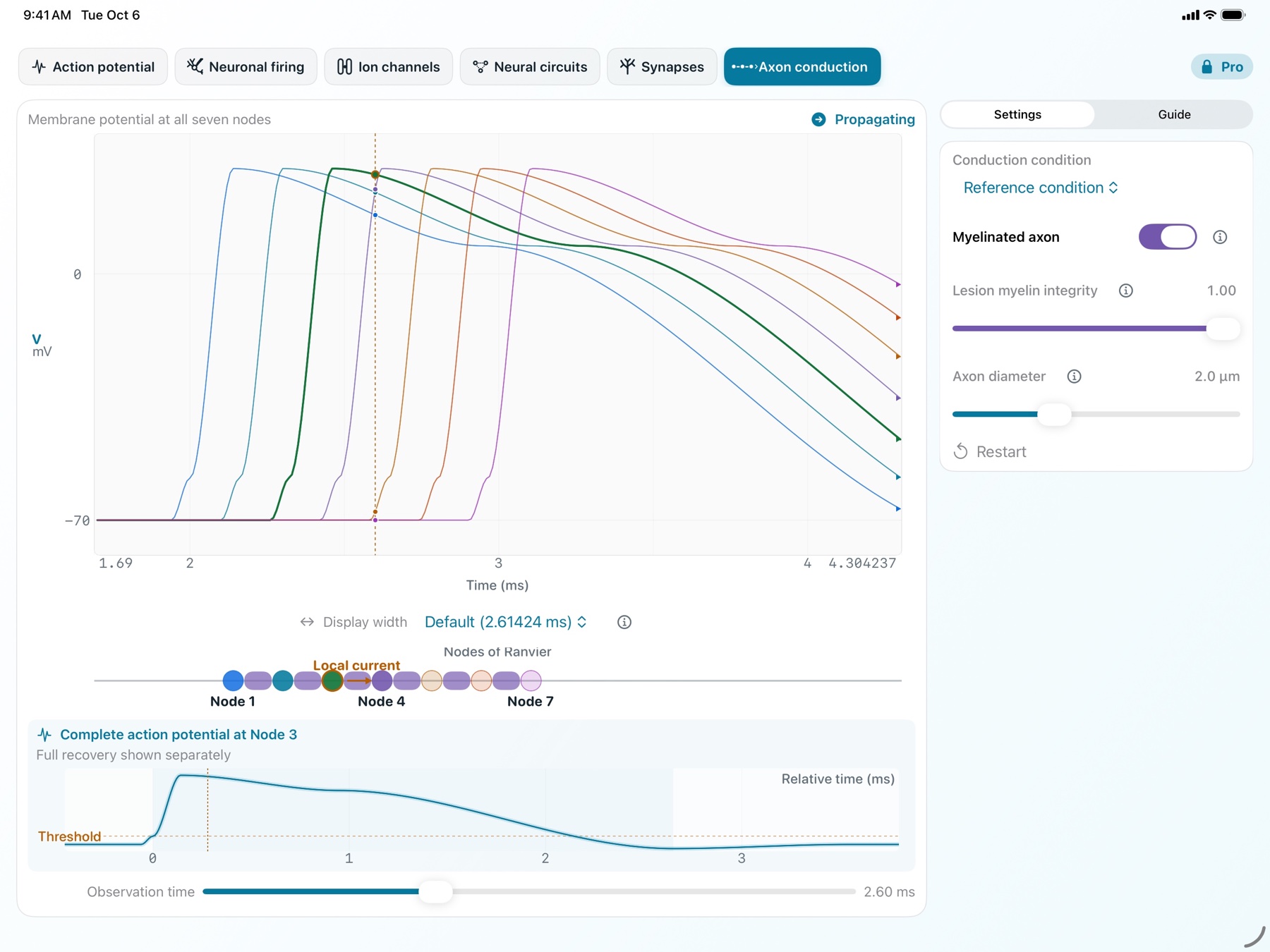
Pro · Click, tap & drag
In Pro editors, click or tap to select a node and drag between nodes to edit circuit connections or dendritic parents. Place synaptic inputs by dragging an input card onto a node.
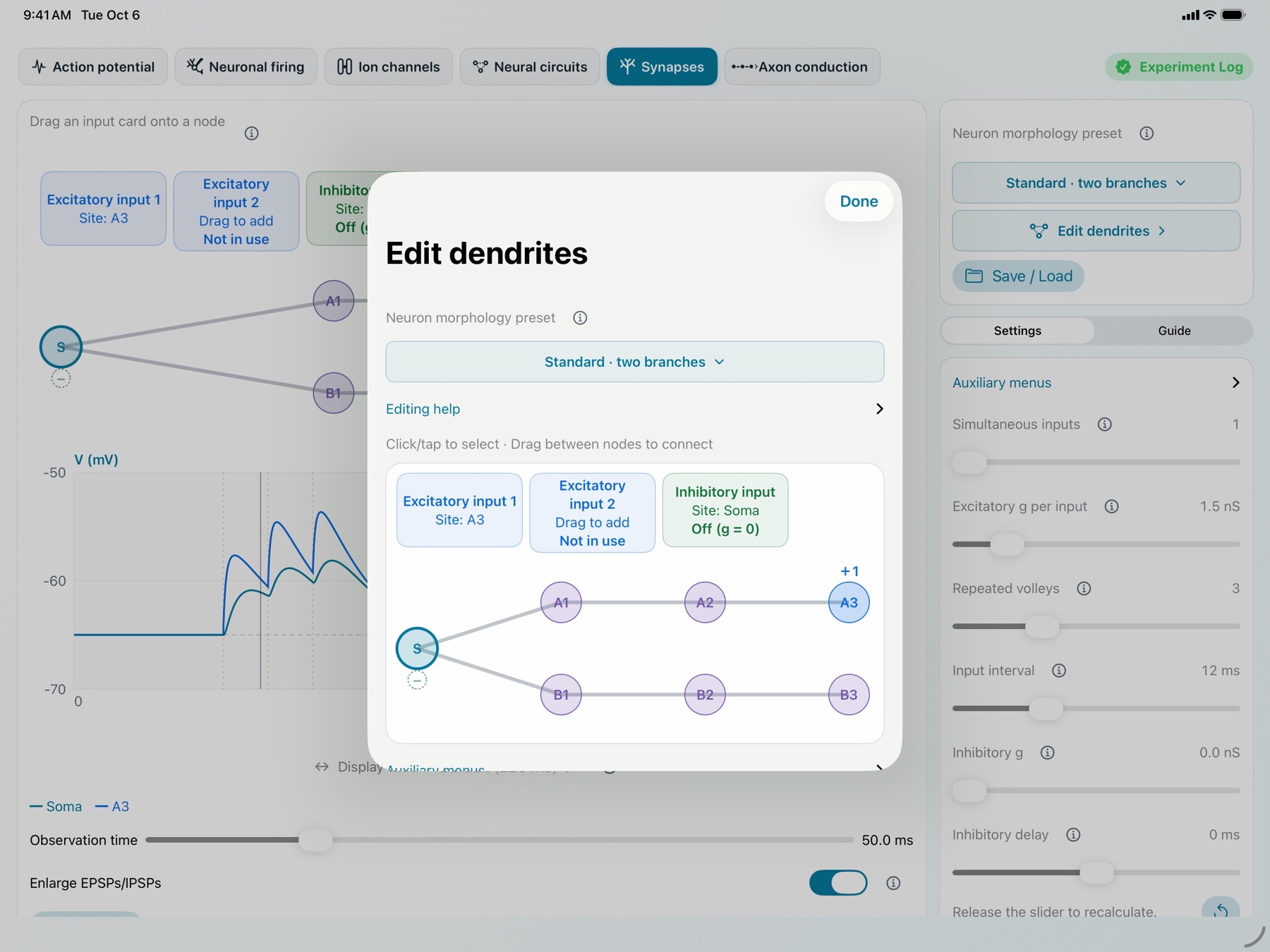
Included
Includes basic settings and guides, foundational action-potential experiments, four circuit presets, the standard dendrite plus four representative morphologies, and four foundational neuron profiles.
Pro
Unlock custom circuit and dendrite editing and saving/loading, experiment records, numerical comparison, CSV export, action-potential conductance controls and comparison, held ion-channel and dendritic traces, and five specialized neuron profiles. Not a subscription.
Other storefronts use the price shown by the App Store. Existing Pro customers receive the new features without another purchase.
Requirements & model scope
Requires iOS/iPadOS 17 or later or macOS 14 or later. Supports English, Japanese, Korean, Simplified and Traditional Chinese, Spanish, French, German, Italian, and Brazilian Portuguese.
Traces and diagrams are models for comparing neurophysiological relationships, not exact reproductions of a particular biological cell or patient. Synaptic dendrites use a passive model without action potentials or NMDA spikes. The app must not be used for diagnosis or treatment.